A battery in a rock.
Polymetallic nodules are the cleanest path toward electric vehicles.
A Nodule Solution
Society has an urgent, growing need for battery metals to transition to clean energy and electric vehicles. We believe that the characteristics of polymetallic nodules may provide an opportunity to compress lifecycle environmental and social impacts of producing critical metals as compared to many land-based projects, and may potentially offer the lightest planetary touch.
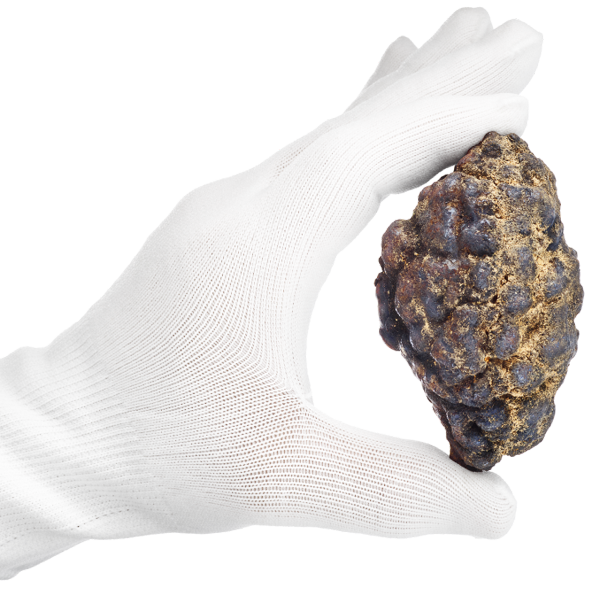
Polymetallic nodules, also called manganese nodules, contain four essential battery metals: cobalt, nickel, copper and manganese, in a single ore. Formed over millions of years by precipitating metals from seawater and sediment pore water, these nodules lie unattached to the abyssal seafloor. Unlike land ores, nodules do not contain toxic levels of heavy elements, and producing metals from nodules has the potential for us to productize nearly 100% of nodule mass and design a metallurgical flowsheet that generates no tailings and leaves nearly no solid waste streams behind.
Planetary Potential
Polymetallic nodules were discovered in the 19th century. In the 1970s, four consortia started to collect the rocks to determine the commercial viability of their exploitation. The initial tests suggested that nodules could be collected and processed to produce usable metals with the technology available at the time, but the activity was paused, for various reasons, including the absence of a governing body to oversee any activities in the deep ocean in international waters.
The International Seabed Authority (ISA) was set up by the U.N. in 1994, and the organization granted the first license for exploring polymetallic nodules to our subsidiary Nauru Ocean Resources Inc. (NORI) in 2011. The Metals Company now holds certain rights to exploration contracts granted by the ISA through three subsidiaries: NORI, sponsored by the Republic of Nauru; TOML, sponsored by the Kingdom of Tonga; and DeepGreen Engineering Pte. Ltd., which has an arrangement with Marawa Research and Exploration Limited, a company owned and sponsored by the Republic of Kiribati.
Through surveying with underwater drones and taking box core samples, we’re able to estimate the grade and abundances of minerals in our exploration areas. The NORI area alone contains enough metal to potentially supply battery metals for 140 million electric vehicles. We believe our contract areas have estimated in situ quantities of these metals in quantities equivalent to the requirements for 280 million EVs, roughly the size of the entire U.S. passenger vehicle fleet on the road today.
Using nodules to create EV batteries is expected to generate, on average, 90% less CO2 equivalent emissions than using ores from land-based mines. Nodule exploitation also means no disruption to Indigenous communities, no deforestation and no child labor during the mining phase..
Collecting Rocks
The Metals Company plans to lift polymetallic nodules to the surface, take them to shore, and process them with near-zero solid waste, no tailings or deforestation, and with careful attention not to harm the integrity of the deep-ocean ecosystem.
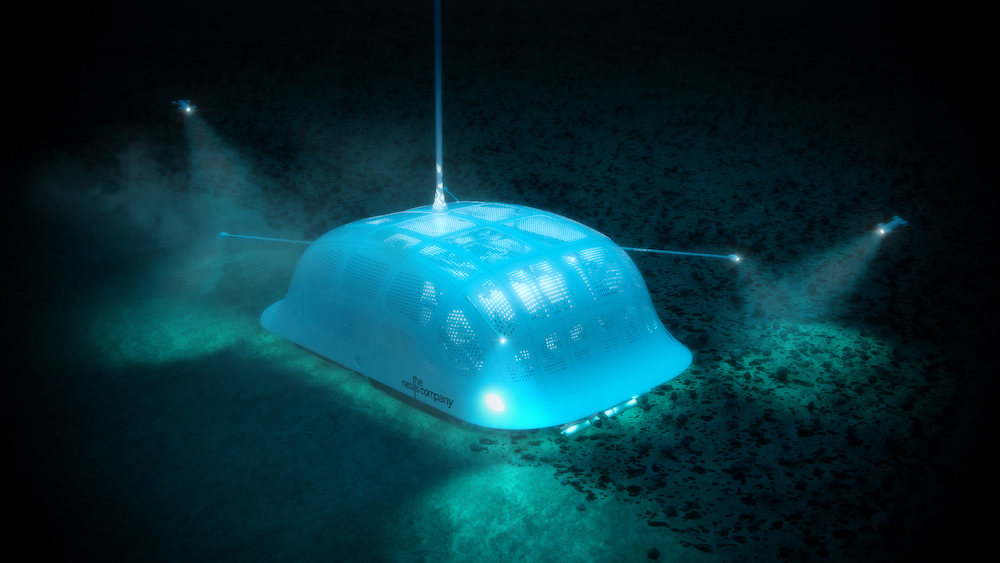
Our production process begins with the collector, designed to collect polymetallic nodules from the abyssal seafloor. Over 90% of the entrained sediment is expected to be separated from the nodules inside the collector and discharged behind it, with most sediment settling back to the seafloor within a few hundred meters. From the collector, nodules travel up a riser system to our production vessel. Once aboard, nodules get dewatered and residual water, sediment and nodule fines will be returned below the photic zone to a depth scientifically chosen to have minimal impact on the collection area.
Throughout this process, the adaptive management system, a mix of marine hardware and cloud-based artificial intelligence designed to create a virtual replica of the deep-sea environment, will give eyes and ears to the regulator and various stakeholders during operation and potentially enable us to have the lightest impact on the marine ecosystem, from the surface to seafloor. The nodules are then expected to head to shore where they’re offloaded for processing.